
News and Information
POTA Corner:Chasing the Rhino
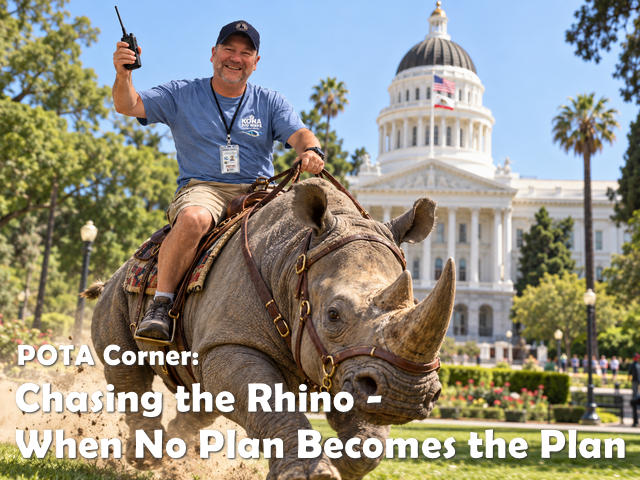
Follow Jimmy/N6FMD on his quest for the Rhino Award!
POTA Corner: Chasing the Rhino — When No Plan Becomes the Plan!
By Jimmy Landrum, N6FMD
October 23, 2026 | Friday
Sometimes the best adventures are the ones you never planned. On Friday, October 23, I unexpectedly earned my first POTA Rhino Award by activating ten unique park references in a single UTC day. What started as a simple trip to Old Sacramento turned into a full day of radio challenges, questionable band conditions, spontaneous decisions, and a race against the clock. Here’s how it all happened!
The Rhino: A Year in the Making
For more than a year, I had been planning a trip to earn the POTA Rhino Award, formally known as the Rover Rhino. For those unfamiliar with the challenge, the award recognizes an amateur radio operator who successfully activates ten unique park references within a single UTC day.
My original plan was to tackle ten parks along the Pacific Coast Highway. One thing I had not seriously considered was attempting the challenge in the Sacramento metropolitan area. Not because there weren’t enough parks, mind you. In fact, there were plenty!
Six parks in downtown Sacramento alone looked promising on paper. Add a two-fer at Folsom Powerhouse State Historic Site and a three-fer at Prairie City OHV Park, and ten parks seemed entirely achievable.
Easy, right? Six downtown parks, a quick drive to Prairie City, another short hop to Folsom, and voilà — Rhino Award!
Well, as they say, the devil is in the details.
Downtown Sacramento: Great on Paper, Tough on the Radio
My reconnaissance work quickly showed why I had initially ruled out a downtown Sacramento Rhino run. The biggest challenges were operating conditions and logistics.
First, there’s the urban environment. Downtown parks are surrounded by multistory buildings made of brick, concrete, and steel — not exactly the ideal neighbors when you’re trying to get a radio signal out.
Then there’s the noise. The noise floor downtown routinely hit S7 or worse, and this wasn’t the kind of noise you could easily clean up with digital processing or filtering. It hissed, snapped, crackled, and popped. Sometimes it sounded less like amateur radio and more like a bowl of Rice Krispies!
During my initial reconnaissance, I activated at Sutter’s Fort, Old Sacramento, and the State Capitol. Rather than trying to activate multiple parks in one day, I wanted to understand how different times of day and band conditions affected operations.
The results weren’t encouraging. It averaged just over two hours of radio operating time to make ten SSB contacts at each park. Remember, that was radio time alone — no setup, teardown, or travel included. I estimated that activating five downtown parks would take at least six hours.
And then came the logistics.
Parking near potential activation spots was difficult. Finding a suitable place to set up was even harder. Add foot traffic, security, police, and the need to comply with site rules and regulations, and you begin to appreciate the challenge.
The Railroad Museum presented its own obstacle course. You can’t drive up and park at the museum, so operating from the car wasn’t an option. To count the Pony Express Trail, you must operate within its boundary on the south side of the museum along Second Street.
That means setting up on a busy sidewalk, with a brick and concrete wall behind you, a multistory parking structure across the street, and an interstate overpass nearby. Add downtown noise, and you’ve got quite the operating environment!
Discouraged yet? Hang on — there’s more.
The State Capitol doesn’t permit antennas to be set up without a permit. Leland Stanford Mansion was another challenge. I made four attempts to operate there, but limited parking and space defeated me every time. I also got the impression that setting up a conventional radio and antenna system wouldn’t be particularly welcome.
To this day, I still haven’t activated Leland Stanford Mansion.
The bright spot was the State Indian Museum, east of Sutter’s Fort. The park rangers allowed a discreet radio and antenna setup, and there were a few quiet spots away from the main foot traffic within the boundaries of both the museum and the fort.
After all that reconnaissance, I scrapped my Sacramento-area Rhino plan and returned to my original idea: a ten-plus-park run along the Pacific Coast Highway.
Or so I thought.
Thursday Night: A Change of Plans
Here’s the funny part: nothing really changed my mind about Sacramento. I simply stumbled into the opportunity!
On the evening of Thursday, October 22, my wife told me she needed a ride to work Friday morning. She was getting a company car and would be driving it home after work.
Since I’d be near downtown anyway, I figured I might as well activate Old Sacramento. I wasn’t exactly jumping for joy at the prospect, given my earlier experiences, but it seemed worth a try.
My initial plan was to operate from the top of the Old Sacramento parking garage off I Street. The garage officially opens at 8 a.m., although I’ve managed to get in as early as 6:30 a.m.
The garage is an ideal location for a two-fer: Pony Express Trail US-4578 and Old Sacramento US-3525. The Hastings Building, formerly the Pony Express Station, sits directly across the street. The open rooftop also allows you to operate from your vehicle.
Pro tip: Park along the Second Street side of the garage to stay within 100 feet of the Pony Express Trail.
When I arrived, I parked, leaned over the wall, and looked around. There was no one in sight. And when I say no one, I mean absolutely no one. Old Sacramento was practically a ghost town.
I grabbed my G90 bag and laptop and headed down the stairs to Second Street, which is also part of the Pony Express Historic Trail. From there, I wandered over to the wooden walkway and made my way to the Sacramento Railroad Museum US-3415.
Park One, Two, and Three: SSB Says No!
By around 7:30 a.m., I had settled beside the brick wall on the south side of the museum. It was early, quiet, and a little nerve-racking, but I set up my M010 antenna, fired up the G90, and started calling CQ.
It didn’t take long to realize that SSB voice wasn’t going to cut it. Time for Plan B!
I switched to FT8 and started calling CQ POTA. After about an hour and a half, I had enough contacts to complete the activation.
Just as I made my final contact, a security guard appeared around the corner to investigate what I was doing. I explained that I was playing radio, gave him the quick version of Parks on the Air, and let him know I had just finished. We chatted for a while, and then I packed up and headed back to the car.
On the way, I noticed that traffic was still light and the streets were relatively empty. Since I was already downtown, I figured, why not try another park?
Next stop: Leland Stanford Mansion US-3459.
As expected, that was a no-go.
From there, I headed to State Capitol Park US-3413. To my surprise, I found open parking spaces along N Street toward 15th Street. I paid for parking, swapped the 2-meter antenna on the car for a 15-meter Shark stick, ran the coax through the window, and settled in with my G90 and laptop.
I fired up 15-meter FT8 and started calling CQ POTA.
Another hour and a half later, I had my activation.
By this point, I was questioning my life choices. The noise was awful, SSB voice was useless, lunchtime was approaching, and collecting ten contacts at each park was taking far longer than I had hoped.
I was seriously considering calling it a day.
The Five-Park Temptation
Then I did the math.
It was around 12:30 p.m., and I had activated four unique park references:
- Pony Express Trail — US-4578
- Old Sacramento — US-3525
- Sacramento Railroad Museum — US-3415
- State Capitol Park — US-3413
I needed just one more park to earn the POTA Rover Award, which recognizes five unique park references activated within a single UTC day.
My first thought was to head to Folsom Lake. But after considering my options, I decided the State Indian Museum at Sutter’s Fort would be a better choice.
I was already worn down by the downtown noise. The constant hissing, snapping, crackling, and popping had taken its toll, and the thought of another downtown activation wasn’t exactly thrilling.
Still, I hadn’t activated the State Indian Museum US-3572, and it would count as a new unique park reference. So, reluctantly, I headed toward Sutter’s Fort US-3575 and the State Indian Museum.
Fortunately, parking spaces were available on K Street, directly in front of the museum entrance. Even better, there was a small, shaded grassy area along the side of the building.
I sat on the ground, set my G90 on a small camping table, connected my JPC-12 antenna, and got to work.
I started on 15-meter FT8 but had to switch to 20 meters to collect my final four contacts. The noise and band conditions were still less than ideal, but this activation was much more enjoyable than the others.
In fact, I enjoyed it enough that I’ll probably return for another activation!
A little over an hour later, I packed up with six successful park references behind me:
- Pony Express Trail — US-4578
- Old Sacramento — US-3525
- Sacramento Railroad Museum — US-3415
- State Capitol Park — US-3413
- State Indian Museum — US-3572
- Sutter’s Fort — US-3575
Six parks down. Four to go.
I was tired, the radio conditions were still challenging, and going home was looking pretty attractive.
But there was that little voice in my head: You only need four more for the Rhino.
And just like that, I was back in the game!
Prairie City: The Rhino Is Within Reach
I headed east on Highway 50 toward Folsom, exited at East Bidwell, turned onto White Rock Road, and made my way to the three-fer operating spot near Prairie City OHV Park.
Prairie City Park US-3544 has a useful staging area near the main entrance and park sign. The spot is within 100 feet of White Rock Road, which provides access to the Pony Express National Historic Trail US-4578 and the California National Historic Trail US-4566. Both trail signs are posted near the far exit from the staging area which is officially part of Prairie City Park US-3544.
This was starting to look promising!
I was getting excited about the possibility of actually reaching ten parks, although I still had some doubts. It was getting later in the afternoon, and the bands weren’t doing me any favors.
I decided not to bother setting up outside the vehicle. Instead, I stayed in the car and operated FT8 with the G90, using 15-meter and 20-meter Shark sticks mounted on the roof.
Getting those ten contacts felt like it took forever. But eventually, I got them — and a few extra for good measure!
With Prairie City activated, my confidence grew. I was now convinced that the Rhino might actually happen. There was just one problem: it was approaching 3 p.m., and I had only about two hours left in the UTC day.
One final stop remained.
The Final Push: Folsom Powerhouse
Folsom Powerhouse State Historic Site US-3433, which is also a part of Folsom Lake US-3432, was only about fifteen minutes away.
Or at least it was supposed to be.
My GPS announced “unusually heavy traffic,” increasing the estimated drive to twenty minutes. Every extra minute felt like the UTC clock was ticking louder.
I decided before I even reached the parking lot that I would operate from the car. There was no time to waste setting up a more elaborate station, and I was beginning to worry that I might run out of time before making enough contacts.
Once I arrived at Folsom Powerhouse, I found an open parking spot without trees blocking the antenna. I got settled, fired up the radio, and started calling CQ POTA.
This time, the contacts came through without too much drama.
And then it happened.
TEN PARKS IN ONE UTC DAY — THE POTA RHINO AWARD!
No grand plan. No carefully executed Pacific Coast Highway expedition. No year-long strategy coming together exactly as expected.
Just a spontaneous series of events, a willingness to keep going, and a whole lot of FT8.
Sometimes the best adventures really are the ones you never planned.
What I Learned Along the Way
Looking back, this unexpected Rhino run reinforced a few lessons that are worth sharing with fellow POTA operators.
1. Reconnaissance pays off.
Take the time to scout out the parks you want to activate. Visit the locations in person, study satellite images on Google Earth, or talk to someone who has activated there before. Knowing where to park, where to set up, and what restrictions you might encounter can save a tremendous amount of time and frustration.
2. Know your gear — and have options.
Be familiar with your equipment and how it performs. When possible, have multiple radios and antenna systems available. Be flexible, because conditions can change quickly, and the setup that works at one park may not work at the next.
In my case, switching from SSB voice to FT8 made the difference between struggling to get contacts and successfully completing activations. Having different antennas available also gave me options when I needed them.
3. Be prepared to change the plan.
Even the best plans can fall apart. Parking may be unavailable, a location may not permit antennas, band conditions may be terrible, or unexpected opportunities may appear.
Being able to adapt is a valuable skill in the field. Sometimes, the difference between going home empty-handed and achieving your goal is simply being willing to try something different.
4. Remember why we do POTA.
Parks on the Air is about more than collecting park references and earning awards. It provides practical experience with portable radio operations, improves our understanding of equipment and propagation, and helps us become more capable of communicating when circumstances are less than ideal.
Those skills matter, especially when we need to operate away from our normal stations and familiar surroundings.
The Bottom Line
My first POTA Rhino Award wasn’t the result of the plan I had spent a year developing. It happened because I was prepared, had the right equipment, adapted to changing conditions, and decided — more than once — not to call it a day.
So, the next time your POTA plans go sideways, don’t be too quick to pack it in. You might discover that the next park, the next contact, or the next unexpected turn is exactly what you need.
After all, sometimes the best plan is having no plan at all.
Just make sure you’re prepared when opportunity comes calling!
73 and happy hunting!
Jimmy Landrum, N6FMD